Wen and Leonard’s Relationship
The Cabin at the End of the WorldWen and Leonard’s Relationship begins with Leonard presenting himself to Wen as a gentle new friend, and becomes a painful test of whether the trust he cultivates can survive the terrible purpose he serves. Their early connection is made through small acts of attention: a careful conversation, help with Wen’s grasshoppers, and a flower offered as an early birthday present. But the approach of Leonard’s companions reveals the limit of that intimacy. Wen can remember feeling safe in his arms and still plead for him to leave her family alone.
First Encounter and Earned Confidence
Leonard introduces himself by name, while Wen does not immediately offer her own. Before she can go to fetch her parents, he asks whether she would be comfortable talking with him first. Wen answers with the rule her parents have taught her: “I’m not supposed to talk to strangers.” Leonard does not dismiss the warning. He tells her she is right and smart, promises that he is there to be her friend, and says he will not be a stranger for long. His smile is almost as large as a laugh; Wen returns it without hiding her own smile behind her hand.
The exchange establishes the relationship’s central tension at its beginning. Wen is interested enough to keep talking, but her caution remains active. Leonard’s promise of friendship is not yet proof that he deserves it; it is an invitation that Wen cautiously accepts. His soft, youthful-sounding voice also differs from what she might expect from a man of his imposing size. The contrast helps make him approachable to her, while the story’s later events give that initial gentleness a more unsettling context.
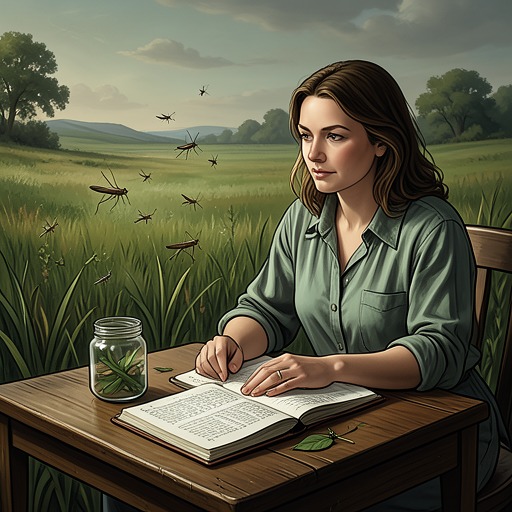
Wen tells Leonard that she catches, names, and studies grasshoppers so she can learn whether they are healthy and help animals when she grows up. Leonard responds with admiration and offers to help. He says that he is much bigger than when he was a child but remains gentle, presenting his size as something he can manage rather than a reason for her to fear him. Wen agrees to let him catch some of the smaller grasshoppers for her, while she holds the jar and keeps its occupants from jumping out.
Shared Attention and the Flower
The grasshopper-catching gives their new friendship a practical form. Wen retrieves the jar, first peering through the cabin’s open windows to check whether her parents are watching or listening. She finds neither parent in the kitchen or living room and thinks they may be relaxing on the back deck. Although she briefly considers telling them she is with Leonard, she instead carries the jar back across the lawn. Her choice shows her willingness to spend time with him, but also that she remains aware of her parents and of the distance between their supervision and her conversation with a stranger.
Leonard follows Wen’s instructions and catches a grasshopper slowly, placing his hands around one hanging upside down from a dried stalk. Wen praises his skill. He then suggests letting the grasshoppers in the jar settle before adding the new one. The care in this exchange is mutual in a modest way: Wen directs the activity and sets limits, while Leonard listens, helps, and treats her interest as worth taking seriously. Their shared attention to the insects makes the promised friendship tangible without requiring Wen to abandon all caution.
Leonard later offers Wen what he calls an early birthday present. She folds her arms and remembers her parents’ warning not to trust strangers, especially strangers bearing gifts. She asks why he wants to give her something. Leonard explains that he thought he might meet her, or someone like her, and that he had picked up the object because he felt he should. The gift is a small, squashed flower. Wen takes it carefully, avoiding accidental contact with his hand, then examines its loose stem, yellow center, and seven long, narrow white petals. Rather than putting it in her hair or in water, she proposes pulling it apart as a game. Leonard laughs when she jokes about its condition and agrees that they should not disturb the grasshoppers’ habitat too much. Her relief is so great that she nearly mock-faints into the grass; she accepts the flower and reshapes its curled stem.
Friendship Meets the Approaching Group
The sound of many people walking down the dirt road changes the scene. Wen asks whether more people are coming, whether they are Leonard’s friends, and whether they are nice. Leonard answers that they are coming, but carefully distinguishes his bond with Wen from his connection to them: he does not know his companions very well and would not exactly call them friends. He says they have an important job, the most important in the history of the world, and hopes Wen can understand. The answer makes clear that their easy lawn-side conversation has been taking place alongside a larger purpose she does not share.
Wen stands and says she has to go inside. The approaching footsteps are close, and she does not want to see the people who are coming. As she backs toward the cabin, Leonard tells her that what is about to happen is not her fault and that she has done nothing wrong, but that her family will face terrible decisions. He is on his knees, with tears in his eyes, and his arms outstretched. His warning carries tenderness, yet it cannot make the strangers or their mission harmless. Wen fumbles up the stairs backward, keeping her eyes on the crude wooden-and-metal weapons carried by the arriving group. Her retreat is the first decisive break between the safety she had begun to associate with Leonard and the danger now entering the scene.
Remembered Safety and a Plea to Leave
Later, amid the confrontation at the cabin, Wen remembers being held in Leonard’s arms while Andrew fought Redmond. She feels ashamed of the memory because, despite what is happening, she remembers feeling safe. That recollection does not erase the threat; it gives the relationship its painful complexity. Leonard’s gentleness has been real enough to leave an emotional impression, but it exists within a situation in which Wen and her family are in danger.
When Leonard steps forward between Eric and Andrew, he places himself physically between the family and the others, then crouches to their level. Wen asks him to leave them alone and to go away, while adding that she will still be his friend. Her plea holds attachment and refusal together: she does not deny the bond formed over the grasshoppers and the flower, but she will not let that bond stand in for her family’s safety. The relationship ends at this point in the evidence not with a simple rejection of Leonard as a person, but with Wen drawing a boundary against what he has become part of. Friendship remains something she offers; access to her family does not.